

AstroMD: Is Consciousness Tapping the Vacuum? Exploring the Zero-Point Energy Hypothesis

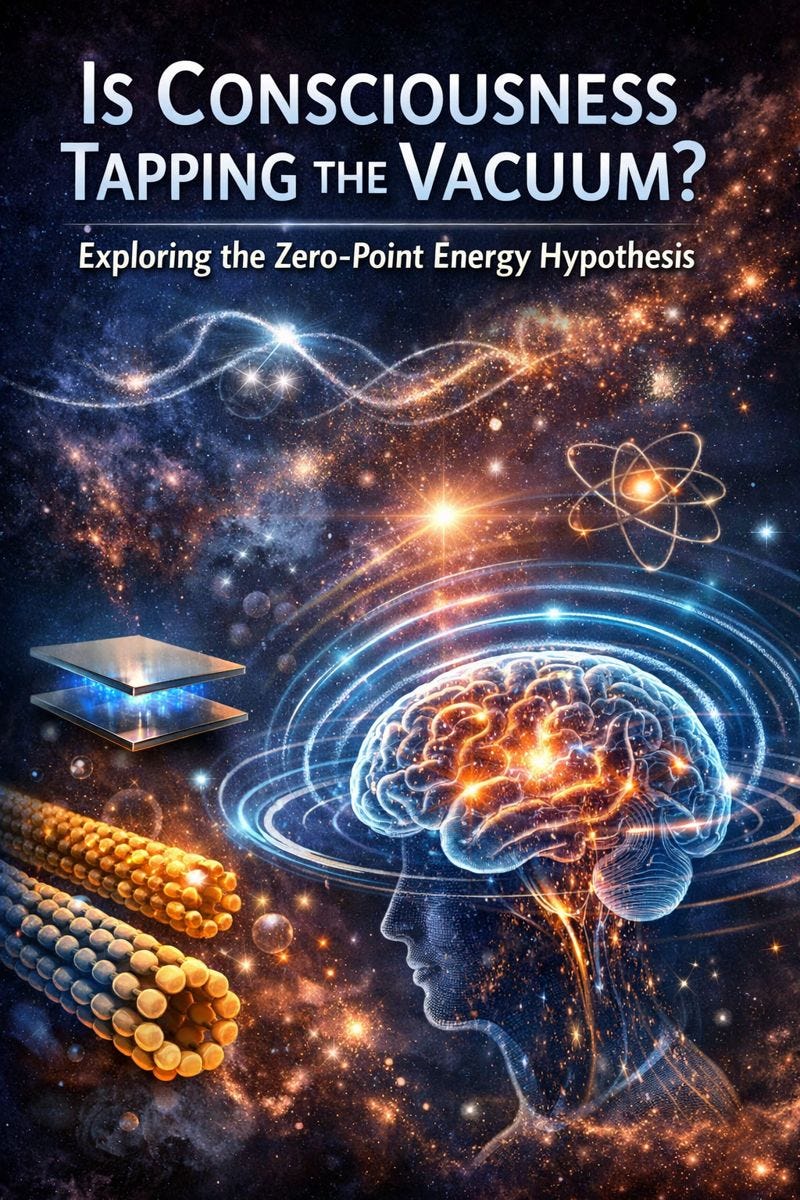
Modern physics agrees on one deeply unintuitive fact: empty space isn’t empty.
Even at absolute zero, when all thermal motion should theoretically stop, the vacuum still hums with activity. Quantum fields fluctuate. Virtual particles appear and vanish. Energy refuses to go quietly to zero. This residual background energy is known as zero-point energy, and it falls straight out of quantum field theory. It has been inferred experimentally through phenomena like the Casimir effect, where two metal plates placed nanometers apart attract one another due solely to vacuum fluctuations.
In other words, the universe has a baseline energetic structure. Space itself is active.
The question explored here is not whether zero-point energy exists. It does. The question is far more uncomfortable, and far less settled:
Could the brain, under certain conditions, interact with this underlying field in ways relevant to consciousness?
Where Neuroscience Quietly Runs Out of Answers
Neuroscience has been enormously successful at identifying neural correlates of consciousness, patterns of activity that reliably accompany awareness. We know which networks light up during wakefulness, dreaming, anesthesia, and coma. We can modulate subjective experience with chemicals, electricity, and lesions.
But there is a gap that refuses to close.
No current theory fully explains why electrical activity in biological tissue should produce subjective experience at all, why there is something it feels like to be a brain, rather than nothing. Integrated Information Theory, Global Workspace Theory, and predictive processing models describe how information is organized and shared, but none convincingly bridge the divide between mechanism and experience.
This may reflect a deeper limitation: consciousness might not be fully explainable using purely classical, local, bottom-up models of matter.
That possibility has led some researchers to look elsewhere.
The Zero-Point Energy Hypothesis, Stated Precisely
The zero-point energy (ZPE) hypothesis of consciousness does not claim that the vacuum is conscious, that the brain is pulling free energy from space, or that physics secretly endorses mysticism.
The restrained version of the idea is this:
Consciousness may be a fundamental feature of the universe, associated with deep physical fields such as the quantum vacuum, while the brain acts as a biological interface that organizes, filters, and locally expresses that consciousness.
In this framework, the brain does not generate consciousness in the way the liver generates bile. Instead, it modulates, constrains, and stabilizes it, much like a radio does not create music, but tunes into and decodes a signal.
The metaphor is imperfect, but it captures the core intuition: resonance rather than production.
Why Physicists Keep Ending Up Here
Several prominent physicists have argued that consciousness exposes cracks in our current physical models, not because they set out to study the mind, but because their equations forced them to confront unexplained structure in reality itself.
Roger Penrose
Penrose has long argued that human consciousness may involve non-computable processes, which are operations that cannot be reduced to algorithmic symbol manipulation. Classical physics and conventional neuroscience, he suggests, may be insufficient to explain subjective awareness. Alongside anesthesiologist Stuart Hameroff, Penrose proposed that quantum-level processes inside neuronal microtubules might play a role in conscious experience (the Orch-OR model). The specifics remain controversial and unproven, but the challenge itself is important: biology may not be purely classical.
Harold Puthoff
Physicist Harold Puthoff explored stochastic electrodynamics, a framework in which many quantum effects can be modeled as interactions with the zero-point field. In this view, the vacuum is not random noise but a structured background influencing particle behavior, stability, and organization. Some have speculated that complex biological systems could achieve higher-order coherence with this field, allowing information integration that exceeds purely local neural processing.
David Bohm
David Bohm’s concept of the implicate order proposed that reality has a deeper, enfolded structure from which the observable world unfolds. Mind and matter, in this view, are not separate substances but different expressions of the same underlying process. Bohm did not claim to solve consciousness, but his framework shows why a field-based view of awareness does not automatically violate physics.
Why the Brain Might Be Relevant at All
From a biological perspective, the brain is not merely a chemical organ. It is an electromagnetic one.
Neural activity is rhythmic and coherent. Conscious states correlate strongly with large-scale synchronization across distributed networks, particularly in the gamma range. Loss of consciousness, through anesthesia, seizures, or deep sleep, often corresponds to a breakdown in integration and coherence rather than a simple reduction in firing.
At the cellular level, neurons contain microtubules, ordered protein lattices that support intracellular transport and structural integrity. These structures are electrically active and capable of supporting oscillatory dynamics, at least at classical biological scales. Claims of long-lived quantum coherence in microtubules remain speculative, but the broader point stands: biology is far more ordered, resonant, and field-sensitive than once assumed.
If consciousness depends on integration and coherence, it is at least plausible that it involves fields, not just neurons firing in isolation.
Plausible is not proven. But it is not irrational.
Altered States as Stress Tests, Not Evidence
One reason field-based theories keep resurfacing is that certain altered states strain purely local explanations of consciousness.
Psychedelics, deep meditation, near-death experiences, and extreme environments like spaceflight often produce reports of expanded awareness, loss of ego boundaries, altered time perception, and a sense of non-local connection. Neuroimaging suggests these states sometimes involve reduced activity in key cortical hubs rather than a simple increase in neural complexity.
These experiences do not prove that consciousness is field-based. But they do challenge the assumption that awareness scales linearly with neural activity and circuitry density. They suggest that the brain may, under some conditions, act more like a filter than a generator.
Why This Idea Remains Outside the Mainstream
The resistance is understandable.
Right now, there is:
No direct experimental demonstration of brain–vacuum coupling
No agreed-upon mechanism linking zero-point fields to subjective experience
A long history of fringe claims contaminating legitimate inquiry
Science is right to be cautious here. But caution cuts both ways. Many foundational ideas, from germ theory to neuroplasticity, spent decades outside accepted frameworks because the tools to test them did not yet exist.
As I have said many times in my career: The absence of evidence is not evidence of absence. It is a reminder of how young consciousness science still is.
A Responsible Way to Hold the Question
The zero-point energy hypothesis of consciousness may ultimately be wrong. It may collapse under better measurements, improved models, or more complete neuroscience.
But the question it raises is hard to ignore:
Is consciousness something the brain produces or something it participates in?
If awareness turns out to be a fundamental aspect of reality, rather than an accidental byproduct of neurons, the implications would extend far beyond neuroscience touching physics, medicine, philosophy, and how we understand what it means to be human.
For now, the most honest position is not belief or dismissal, but disciplined curiosity.
Because if the universe is humming beneath our feet, it would be strange if biology never learned how to listen.
enjoying the thought
💭